 Engineer Grade Reflective STOP Signs Click to view more
 High Intensity Reflective STOP Signs Click to view more
 Diamond Grade Reflective STOP Signs Click to view more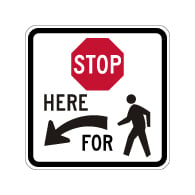
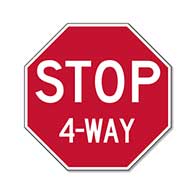
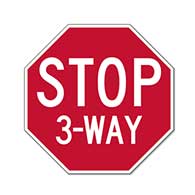
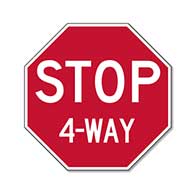









Your shopping cart is currently empty, please browse our inventory by selecting one of the product categories.
STOP Signs
Posting STOP Signs Makes Roadways Safer for Drivers and Pedestrians
Vehicle ownership and use had grown to such an extent by the early part of the 1900s that authorities realized changes were needed to make all streets and roadways consistently safe for people to traverse all throughout the year. As a result, Detroit, Michigan, one of the most influential hubs for automotive manufacturing at the time, was the first city in this country to install STOP Signs in 1915. Unlike the versions that we are so familiar with today, these early models had black letters on a white background. The colors of these signs were changed in the 1920s to black letters on a yellow background. In 1954, the standard colors for the Traffic Stop Signs were once again altered to the white letters on the red background that we are so familiar with today. This decision created signs that conformed to the red stop light in traffic signals.
Read MoreStop Signs Must Fit the Specifications of MUTCD Compliant Signage Today
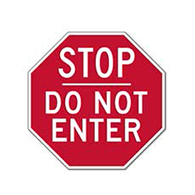
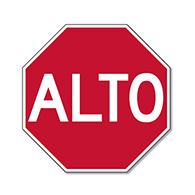
Now that you understand a bit of history on these signs, we bring you up to the present by discussing the fact that today, all the Traffic Stop Signs must adhere to the regulations stipulated in the Manual of Uniform Traffic Control Devices or for short, the MUTCD, to comply with current laws and specifications to keep them uniform in dimensions, materials and colors not only in this country but also worldwide. Even with the languages differing, these Reflective Stop Sign options need to be made according to the regulations of the MUTCD. These regulations ensure that all signs on roads, highways and streets are consistent and therefore, easy to recognize and understand. Regardless of where people drive, they will see identical Reflective Stop Sign options in each location. This holds true for all traffic stop signage and STOP Paddle Signs.
STOPSignsAndMore.com Manufactures and Sells a Wide Assortment of Official MUTCD Reflective STOP Sign Options and Other Road Signs
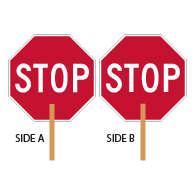
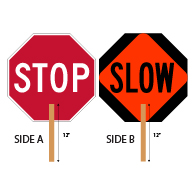
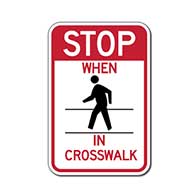
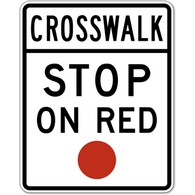
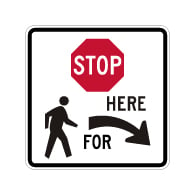
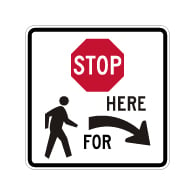
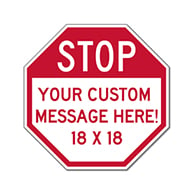
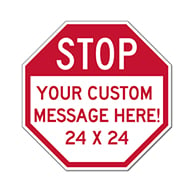
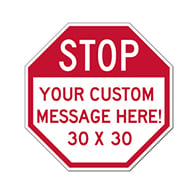
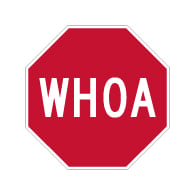
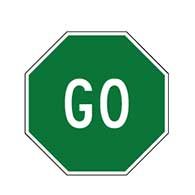
Our company makes and sells MUTCD-compliant STOP Paddle Signs, other STOP signage options and even custom crosswalk signs. Also, we offer green road signage with the word “GO” on it to fulfil the needs for this type of signage by various parties. All of the above sign options are available in standard and custom versions to ensure that they fulfil the needs of our clients effectively.
We Use Only Durable Materials When Manufacturing Our Vast Array of MUTCD Compliant Signage Options
Our STOP signage selection is made with heavy-duty aluminum in accordance with the regulations set forth in the MUTCD. You also have the following variant choices in our signs:
- Engineer Grade Prismatic or EGP – This reflective level complies with the minimum MUTCD standards for Traffic Stop Signs but is still sufficiently reflective for drivers and pedestrians to read clearly during inclement weather and at any time of the day or night. For this option, we use the 3400 Series of 3M’s Engineer Grade Prismatic or EGP. It often exceeds the capabilities of the ASTM D4956 Type I. Due in part to its effective resiliency, the signs that include it can last as long as seven years.
- High Intensity Prismatic or HIP – Choose this reflective choice when you require mid-level performance from your signs that is four times as bright as the basic level. Along with this benefit, HIP includes a protective coating that helps your signs be resistant to scratches and other problems for at least 10 years. To deliver this HIP with our signs, we use the 3M’s 3930 Series that meets both the ASTM D4956 Type II and the ASTM D4956 Type IV specifications. The value that you receive from this choice is well worth the price.
- Diamond Grade – When you require the highest level of reflectivity for your STOP signage, choose this variant grade since it allows drivers and pedestrians to read the signs easily both near and far as well as at any angle. Diamond Grade provides superior light transmission to distances of up to 500 feet. Our company turns to 3M’s DG3 Series 4000 to deliver this level of performance to ensure that your signs have the capability of lasting as much as 12 years.
Our primary goal is to produce only durable signage at cost-effective prices for all our clients to ensure that they receive a high return on their investment. Feel free to look through the following assortment of STOP Signs and other signage to learn which models suit your purposes the best. You also can contact us for assistance through our Contact Us/Request Quote or phone number, which are both in the upper right hand corner of this page.
Price:
$246.80
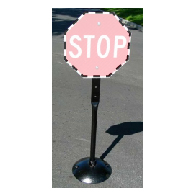
Regular Price:
$139.95
On Sale For:
$119.95
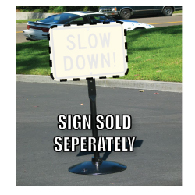
Regular Price:
$144.95
On Sale For:
$134.95